

Market Outlook · Rami Hadad · August 19, 2026
Here’s Why Stop Losses Matter Even With a Bullish Long-Term View
Elite Academy Desk — here is a clear take on the latest market development for traders following the story.
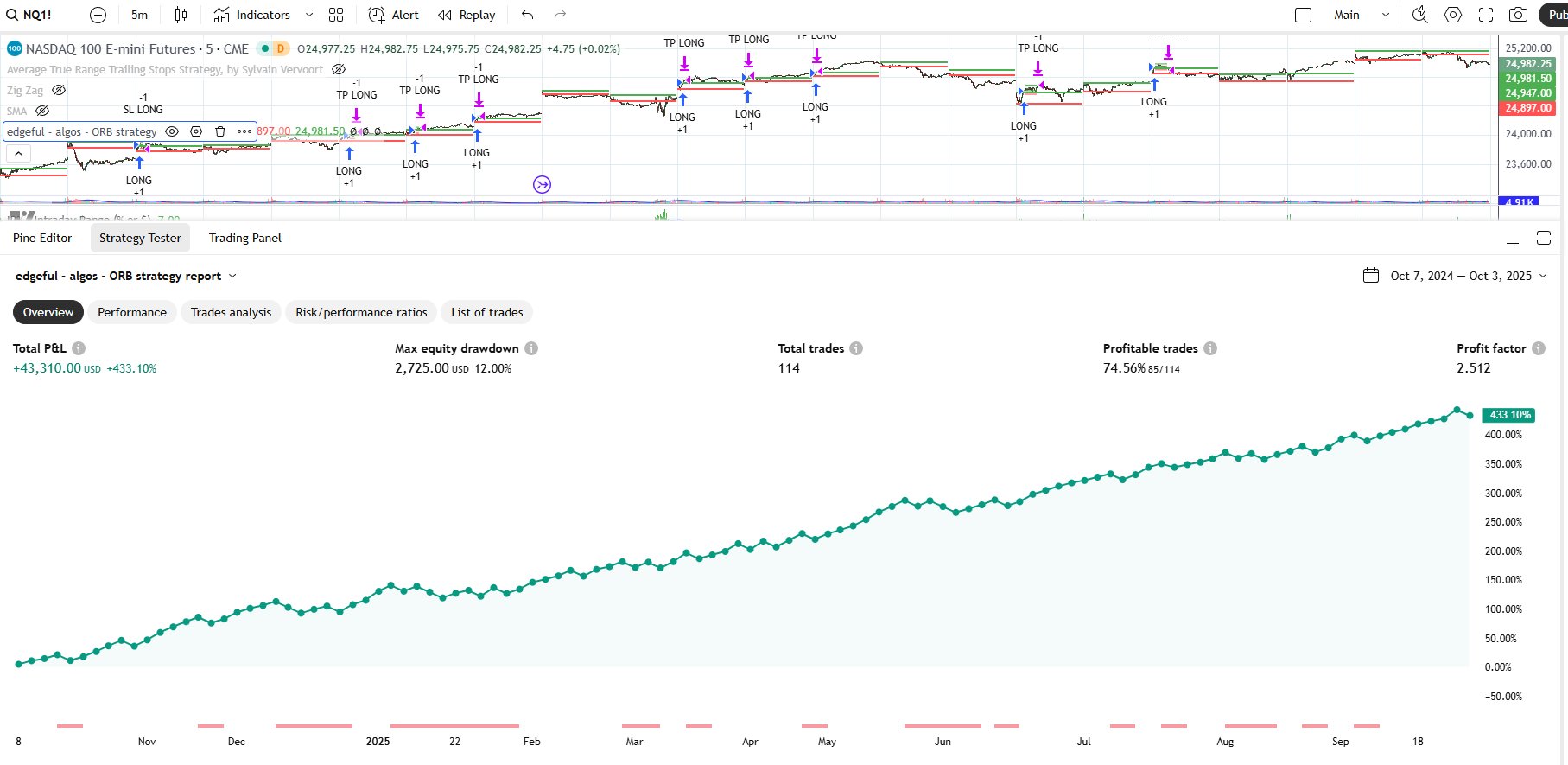
Recently, I sat down for a discussion with Andre, the CEO of Edgeful . Our discussion covered mistakes aspiring traders often make, and tips on improving performance. Finally, we discussed some specific strategies, mainly the Opening Range Breakout Strategy. The strategy is up 170% or 250% over the last year, based on going long and short, or only long. That’s making one trade a day…and it can be fully automated. Edgeful has created Algos that you can load and backtest in TradingView (plots all trade levels for you), or connect to your broker to have trades placed automatically. Edgeful is a research platform that shows the statistics on a wide range of patterns and circumstances, such as how often gaps fill, how often the market finishes higher or lower based on the opening hour (or other amount of time), how often a stock/future/currency pair reaches its average daily range, and much more. Run statistical studies on a wide range of stocks, ETFs, futures contracts, and currency pairs. But let’s get back to the interesting part. A simple strategy that produced well into triple-digit gains over the last year, making only one trade a day. This article was originally written on October 6, 2025. I have kept the original article and criteria intact, which were relevant when the article was written. At the bottom, I have provided updates on how the strategy criteria change over time based on the information and moves the market is giving us. I actually noticed a few things on the call, and found that the default settings, which produced the above results, weren’t capitalizing on the really big movement days. A small adjustment for that, and the profit jumped to 433% over the last year. That’s a $43,310 profit on a $10,000 futures account trading 1 contract of the Nasdaq E-mini (NQ). For a smaller account, consider trading MNQ (Nasdaq E-micro). That’s a fantastic return for making one trade a day. It does not account for commissions or slippage. Because it is only one trade a day, commissions didn’t adjust the overall profit by much. As you know, historical results are not always indicative of future performance. In my own backtest, which differs slightly from the one run during the video, the strategy produced 114 trades. 74.56% were profitable. Profit factor was 2.512. The max drawdown was $2,725, or about 12% of the account balance at the time. If that drawdown occurred when trading commenced, that would be a 27.25% drawdown on a $10,000 account. Because of the high win rate, consecutive losses are fairly rare. There were 3 separate instances of two losses in a row over the 114 trades. No instances of three losses in a row, although it could certainly happen. This is for a $10,000 account, and trading 1 futures contract through the entire year. Positions were NOT scaled up as the account grew. The loss per trade was capped at $1000 . That is 10% of the starting account balance, but that risk would drop as the account grows. That’s more risk than I usually take on per trade, but because of the high win rate, the account was never really in danger (if the largest loss occurred near the beginning, it would have been down 27.25%). The equity curve near the top shows how the strategy tends to bounce back quite quickly…or at least it did over the last year. To risk less, keep the same parameters with a $20,000 account. The dollar profit remains the same at $43,000, risk is halved (5% per trade at the beginning, but drops as the account gets bigger), and percentage profit is also halved to 216%. Or use a $30,000 account to further reduce percentage risk and percentage returns. [I actually have a position sizing method based on maximum acceptable drawdown . It doesn’t consider individual trade risk. This position sizing method may risk 3% to 5% or more of the account routinely, because even in the event of many losses in a row, the drawdown would be within my acceptable level. Only recommended for very well-tested strategies.] Futures contracts are inherently leveraged. So returns would be dramatically less trading an ETF, even a leveraged ETF like TQQQ (26.7% over the last year). Meanwhile, it is advisable to run stats on every instrument, even if they seem related, because results will be quite different if trading ES futures, for example. Different volatility levels and tendencies would mean different parameters used f
Related articles
- Commodities Trade Mixed Signals on Tuesday, Gold Holds Steady
- Markets Update: S&P 500 Holds Steady as Commodities Trade in Mixed Gears Ahead of CPI Release
- Markets Dip Ahead of US CPI Release
- Dow 30 Rises to 4,154.42 as Intraday Momentum Sparks Long Bias
- Dow 30 Rallies to 4,154.42 as Traders Seek New Buy Breakouts
- Global Commodities Trade Slightly Up, Oil and Gas Slip Ahead of Fed Meeting